


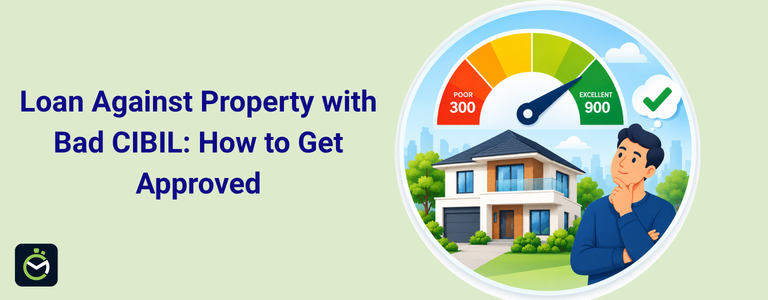
A low credit score can feel like a closed door, especially when you need money urgently for a medical bill, a business expense or a child's education. The good news is that if you own a property, the door is often not fully shut.
A loan against property (LAP) is a secured loan: you pledge your home, shop or other property, and the lender lends against its value. Because the lender has that security, a weak CIBIL score matters less than it would for a personal loan or credit card. It still matters, though, and it will affect the terms you get. This guide explains how.
Can you get a loan against property with a bad CIBIL score?
Yes, in many cases. Since the property backs the loan, some lenders, especially NBFCs (Non-Banking Financial Companies), will consider applicants with lower scores. Approval is never guaranteed, because each lender has its own policy.
Expect three trade-offs:
Higher interest rate: The lender charges more to cover the extra risk.
Lower loan amount: Lenders commonly offer around 60 - 75% of the property's market value to borrowers with good scores. With a low score, you may be offered less, sometimes 50 - 60%. The exact figure depends on the lender.
Extra conditions: You may be asked for a co-applicant with a strong credit profile, or for more income proof.
What counts as a "bad" CIBIL score?
Your CIBIL score is a three-digit number between 300 and 900, prepared by TransUnion CIBIL from your credit history and repayment behaviour. Lenders consider this information to assess your repayment behaviour.
| CIBIL Score Range | What it generally means for a LAP |
| 750 - 900 | Excellent. Best rates and smoother approval |
| 700 - 749 | Good. Approval is likely, with competitive rates |
| 650 - 699 | Fair. Approval possible, often at higher rates |
| 550 - 649 | Weak. Difficult for unsecured loans, but some lenders may consider a LAP with conditions |
| 300 - 549 | Poor. Approval is hard, and it usually needs strong property value, income proof or a co-applicant |
These bands are a general guide. Every lender sets its own cut-off, so a score that one lender rejects may be acceptable to another.
How does a low CIBIL score affect a loan against property?
Lenders consider your CIBIL score along with other factors when evaluating your loan application. A lower score may indicate past payment delays, defaults or other issues in your credit history.
For a Loan Against Property, lenders may also consider:
- Your income level and employment or business stability
- Existing loans and monthly repayment obligations
- Previous defaults or overdue accounts
- The property's current market value and estimated sale value
- The property's ownership and legal documentation
- The requested loan amount
- Your repayment capacity
- The purpose of the loan
- The lender's internal credit policy
A borrower with a low score but strong income, manageable existing debt and a suitable property may have a different outcome from someone with the same score but significant outstanding obligations.
Suggested Read: Does CIBIL™ Score Affect Loan Against Property?
How do lenders assess a loan against property application?
Although the exact process varies between lenders, a typical LAP application involves several stages.
Step 1: Submit the Application
You provide your personal, employment or business details, the required loan amount and information about the property you intend to offer as security.
Step 2: Submit the Required Documents
The lender reviews identity, address, income, banking and property-related documents. Requirements may vary based on the lender’s policies and the applicant’s financial profile.
Step 3: Property Evaluation
The lender may arrange a property valuation to determine its value and suitability as collateral.
The property's location, type, condition, ownership and legal status can all be relevant during the assessment.
Step 4: Credit and Financial Assessment
The lender evaluates your overall financial profile, including your credit history, income, existing commitments and previous repayment records.
Step 5: Loan Amount and Terms
Based on the property assessment and your financial profile, the lender determines the amount it is willing to offer and the applicable interest rate, tenure and other terms.
Step 6: Legal and Documentation Checks
The lender verifies the property documents and completes the required legal and technical checks before sanctioning the loan.
Step 7: Loan Agreement and Disbursal
Once the terms are accepted and the required documentation is completed, the loan agreement is executed and the approved amount is disbursed according to the lender's process.
Step 8: Repayment
You can repay the loan in regular EMIs as outlined in the loan agreement. Delayed or missed payments may lead to additional charges and can negatively impact your credit history.
Eligibility Criteria for Loan Against Property with Bad CIBIL
Requirements differ by lender, but these are the main factors, and they matter even more when your score is low:
- A clear, marketable property: It should have clean legal title and no disputes, and it should not be in a restricted or non-lending zone. Some lenders are cautious about vacant land or very old buildings.
- Stable income: Regular salary credits or steady business income help a lot.
- Manageable existing debt: Lenders look at your FOIR (Fixed Obligation to Income Ratio), which is the share of your monthly income that goes to EMIs. Many lenders prefer it to stay below about 40-50%, though policies vary.
- Work or business stability: Frequent job changes can raise questions. Many lenders like to see a few years of overall experience, or a business that has run for a few years.
- Age: Applicants are usually between 21 and 65, depending on the lender.
Documents required
Keep these ready to speed things up. Lenders may ask for more.
For everyone (KYC):
- PAN card
- Aadhaar or another officially valid ID
- Address proof (utility bill, passport, voter ID or similar)
- Passport-size photographs
- Copies of the property documents: sale deed, title documents, tax receipts, and the approved plan, if required
Salaried applicants:
- Salary slips issued for the most recent 3 to 6 months
- Last 6 months' bank statements
- Form 16 or income tax returns filed for the previous 2 years
Self-employed applicants:
- Income tax returns from the previous 2 to 3 financial years
- Business financial statements, including profit and loss account and balance sheet, for the previous 2 to 3 years
- Bank statements for the most recent 6 to 12 months
- Business proof, such as GST registration or a license
How to improve your chances of approval?
1. Add a strong co-applicant: A family member with a good credit score and steady income can make a big difference.
2. Ask for a smaller loan: Borrowing a lower share of your property's value reduces the lender's risk. Even a small reduction in the amount can help.
3. Pay down small debts first: Clearing small loans or card balances lowers your FOIR and your credit utilisation, and both look better to lenders.
4. Check your credit report for errors: Check your credit report for incorrect payment records, unfamiliar accounts or other errors. If you find inaccurate information, raise a dispute with the lender or credit bureau and request a correction. Keeping your report accurate can help maintain a healthy credit profile.
5. Show that you can repay: Regular salary credits, steady business deposits and a clean recent banking record all work in your favour.
6. Compare NBFCs with banks: Banks usually have stricter credit cut-offs, while NBFCs are often more flexible. The price of that flexibility is typically a higher rate, so compare carefully.
7. Choose the tenure wisely: A longer tenure lowers your EMI and makes approval easier, but you pay more interest overall. Pick the shortest tenure you can comfortably afford.
8. Wait and rebuild, if you can: If your need isn't urgent, a few months of on-time payments and lower card usage can improve your score and save you a lot of interest.
What a bad score can cost you: a simple example
Suppose you borrow ₹20 lakh for 15 years. These figures are illustrative.
| Interest Rate | Approx. Monthly EMI | Approx. Total Interest Paid |
| 12% p.a. | ₹24,000 | ₹23.2 lakh |
| 15% p.a. | ₹28,000 | ₹30.4 lakh |
A 3-point higher rate costs you roughly ₹4,000 more every month and about ₹7 lakh more over the loan. That is why improving your score before you apply, even slightly, can be worth the wait. Use an online EMI calculator with your own numbers for a more accurate picture.
Why loan against property applications get rejected?
- Legal or title problems: Disputed ownership, unclear title or missing documents are among the most common causes.
- Property concerns: The property may be in a restricted area, be unauthorised, face demolition notices, or be vacant land or very old construction, which some lenders avoid.
- Income doesn't meet the lender's minimum: The EMI must fit comfortably within your earnings.
- Too much existing debt: A high FOIR suggests you may struggle with another EMI.
- Unstable employment or business history.
- A very low score with no mitigating factors: With no co-applicant, strong income or good property value to offset it, the application may fall short.
- Incomplete or inconsistent paperwork.
Things to Check Before Accepting a Loan Against Property
A low CIBIL score can make borrowing more expensive, so don't look only at the sanctioned loan amount.
Before accepting an offer, check:
- Interest rate
- Whether the rate is fixed or floating
- Processing and other applicable charges
- Prepayment or foreclosure terms
- Late payment charges
- Loan tenure
- Total repayment obligation
- EMI amount
- Property-related charges, if any
- Terms and conditions in the loan agreement
Most importantly, make sure the EMI is affordable for your current income. A property-backed loan puts an important asset at risk if you fail to meet the repayment obligations.
What happens if you can't repay?
It's important to understand the risk before you pledge your property. If you miss EMIs for a long period and the loan becomes a non-performing asset, the lender can take legal steps to recover its dues. Under the SARFAESI Act, this can include taking possession of the property and auctioning it after giving proper notice. If you run into trouble, speak to your lender early. Options such as restructuring or a longer tenure may be available, and talking sooner gives you more choices.
Final thoughts
A bad CIBIL score makes a loan against property harder and more expensive, but it doesn't make it impossible. Your property, income stability, existing debts and the lender you choose all carry weight. Before you apply, check your credit report, fix any errors, keep your documents in order, and compare offers from more than one lender. Borrow only what you can repay comfortably, because your property is on the line.
Frequently Asked Questions
1. Can I get a loan against property with a bad CIBIL score?
Yes, it's possible, especially with a clear-title property, stable income and manageable debts. The interest rate may be higher and the loan amount lower.
2. What is the minimum CIBIL score for a loan against property?
There's no single number. Many banks prefer 700-750 or above, while some NBFCs may consider lower scores if the rest of your profile is strong.
3. Which lenders are more likely to approve a LAP with a low score?
NBFCs and some housing finance companies are generally more flexible than banks. Always compare rates, processing fees and prepayment terms.
4. Can I apply for a Loan Against Property with a co-applicant?
Depending on the lender's policy, you may be able to apply with a co-applicant. A financially stronger co-applicant may support the application, but both parties should understand their repayment responsibilities before signing the loan agreement.
5. How much loan can I get against my property?
Usually around 60-75% of the property's market value, depending on the lender, the property type and your profile. With a low score, it may be lower.
Disclaimer: This page includes information compiled from many sources and is provided for informational purposes only. Given that this type of data may change over time, we cannot guarantee the accuracy of the information supplied or included within it. It is anticipated that the user will confirm with the relevant source before making any choices or taking any action.