


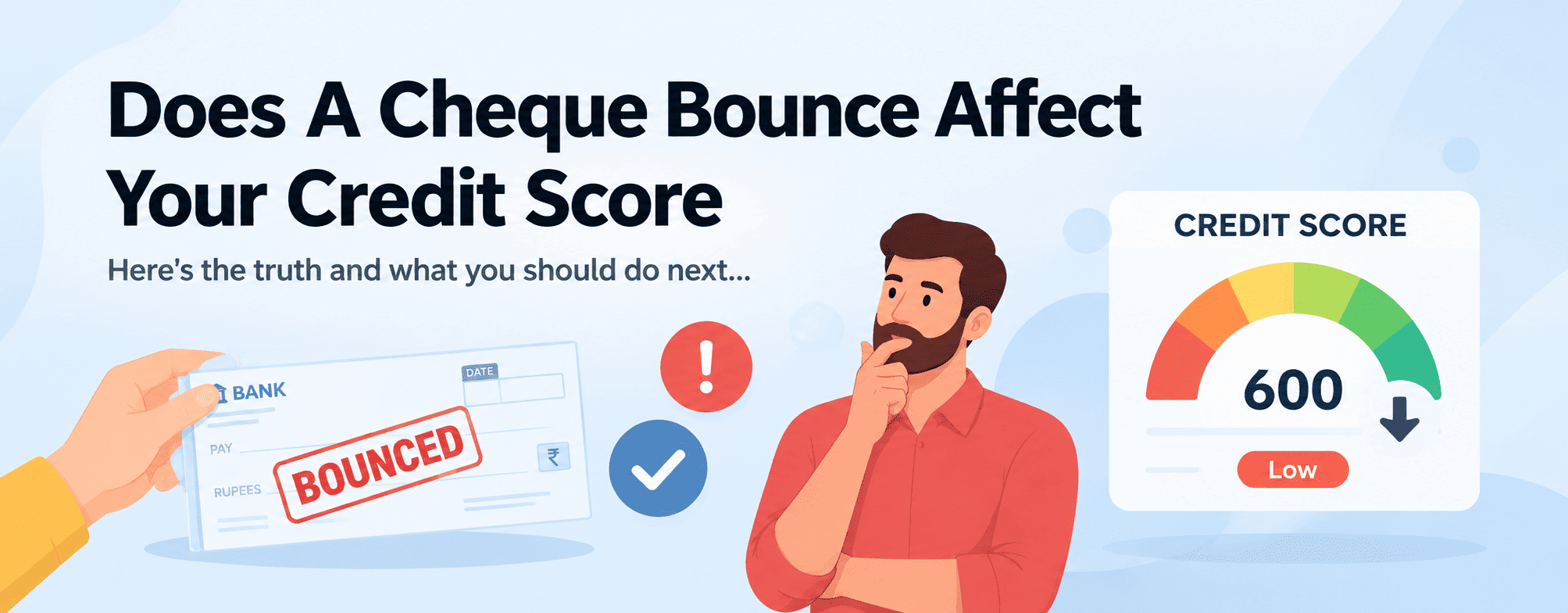
Your cheque just bounced, and now you’re wondering whether your CIBIL score will take a hit. Here’s the short answer: a bounced cheque isn’t reported to the credit bureaus on its own. Your score is at risk only if the bounce causes a missed loan EMI or credit card payment that your lender then reports as overdue.
If the cheque was for rent, a friend or any payment outside the credit system, your score is usually unaffected. In short: the bounce itself isn’t what hurts your score. The missed payment behind it is.
Why Do Cheques Bounce?
A cheque bounces (the bank calls it "dishonoured") when the bank refuses to pay it. The reasons are not always about money:
- Insufficient balance in the account, by far the most common reason
- Signature mismatch with the bank's records
- Amount mismatch between figures and words
- Stale or post-dated cheque: cheques are generally valid for three months from the date written, and presenting one too early or too late gets it returned
- Account closed or frozen
- Overwriting or unclear corrections on the cheque
- Stop-payment instruction from the account holder
The bank records the reason on a cheque return memo given to the person who deposited it. Read this memo first. It tells you whether you have a money problem or only a paperwork problem.
Does a Cheque Bounce Directly Affect Your CIBIL Score?
No, not directly. CIBIL and the other bureaus (Experian, Equifax and CRIF High Mark) track how you repay loans and credit cards. They don’t track your everyday banking, so a single dishonoured cheque doesn’t appear on your credit report.
Your score is affected only when the bounce leads to a missed credit payment. Here’s how that happens:

When You Should Actually Worry
- A loan or credit card payment cheque bounces and stays unpaid: If you pay a home, car or personal loan EMI by post-dated cheque and it bounces, the account can be reported as delayed once the due date has passed without payment.
- An auto-debit (NACH/ECS) fails: Many lenders now collect EMIs through auto-debit mandates. A failed debit is treated like any other missed EMI.
- Bounces keep repeating: One bounce fixed the same day is usually forgiven by circumstances. Several on the same account tell lenders that your cash flow is unreliable, and that can make future loan approvals harder.
- A joint loan is involved: Both borrowers are responsible, so a missed payment can show on both credit reports.
When Your Score Is Usually Safe
- The cheque was for rent, a friend's loan, a vendor or any other payment outside the formal credit system. Bureaus do not receive data on these.
- You cleared the due amount before the lender reported the account as overdue. Reporting timelines differ by lender, so don't assume you have unlimited time.
- The cheque was a security cheque that the lender holds as backup and doesn't deposit unless there is a default.
- The bounce was a minor technical issue, such as a signature mismatch, and you fixed it and paid on time.
The Legal Side: Section 138 of the Negotiable Instruments Act
A cheque that bounces for insufficient funds can also carry legal consequences, separate from your credit score. Under Section 138 of the Negotiable Instruments Act, 1881, the person who received the cheque can take these steps:
- Send a written demand notice within 30 days of getting the bank's return memo.
- The cheque issuer then has 15 days from receiving the notice to pay.
- If payment isn't made, the payee can file a criminal complaint in court within one month after those 15 days end.
- If the issuer is convicted, the penalty can be imprisonment of up to two years, a fine of up to twice the cheque amount, or both.
Under Section 143A, the court can also direct the issuer to pay up to 20% of the cheque amount as interim compensation while the case is still on.
None of this is reported to CIBIL automatically. But a long dispute often means the underlying loan or card account has also gone unpaid, and that is what eventually reaches your credit report. If you receive a legal notice, speak to a qualified lawyer promptly.
Bank Charges Are a Separate Cost
Your bank will usually charge a penalty for a dishonoured cheque, and the amount depends on the bank, the account type and the reason for the return. Financial reasons such as insufficient funds generally cost more than technical ones. Check your bank's current schedule of charges, because these change from time to time. Your lender may also add late payment fees or penal interest on the missed EMI.
How Much Can Your Score Drop?
Nobody can give you an exact number. CIBIL does not publish how many points a missed payment costs, and the effect differs from person to person. These things matter most:
- Whether it was tied to credit: A missed EMI hurts far more than a bounce on a personal payment.
- How long the dues stay unpaid: A short delay is less damaging than one that drags on.
- Your existing record: Payment history is one of the biggest factors in a credit score, so someone with a long clean record may recover faster than someone with a thin one.
- How quickly you fix it: Paying before the lender reports the delay may keep the bounce off your report altogether.
What to Do Right After a Cheque Bounces
1. Read the return memo: Find out why it bounced.
2. Pay the amount again, quickly: Add money to your account if needed and pay through a reliable method (UPI, net banking or a fresh cheque), ideally before the due date or the lender's reporting cut-off.
3. Call your lender: Tell them what happened and ask for confirmation that the payment was received. Lenders tend to be more understanding when you reach out before they chase you.
4. Keep proof: Save the payment receipt, the bank statement entry and any email or SMS from the lender. You may need them later.
5. Check your credit report after a few weeks: Confirm that the account shows as paid on time. You are entitled to one free full credit report per bureau every calendar year, and the bureaus must make the link easy to find on their websites.
6. Move away from post-dated cheques: For recurring EMIs, auto-debit through NACH or UPI AutoPay is usually more reliable and sends you a reminder before each debit.
If Your Score Has Already Dropped
A dip from a missed payment can be repaired, though it takes patience.
- Clear the full overdue amount: Paying only part of it doesn't remove the overdue status.
- Pay on time from now on: Consistent on-time payments over the following months are the strongest way to rebuild.
- Don't apply for several loans at once: Each application usually creates a hard enquiry, and a cluster of them in a short time can make you look credit-hungry.
- Bring credit card usage down: Paying down balances lowers your utilisation, and this can help your score sooner than payment history does.
- Dispute errors: If a payment you made on time still shows as overdue, raise a dispute with the bureau and your lender, with proof of payment. Under RBI's framework, a complaint about incorrect credit information should be resolved within 30 days. If it isn't, you are entitled to compensation of ₹100 for each day of delay.
How to Stop This From Happening Again
- Keep a cushion in the account used for EMIs, above your usual instalment.
- Set reminders three or four days before due dates, not on the day itself.
- Double-check the date, amount in words and figures, and your signature before handing over a cheque.
- Prefer auto-debit over post-dated cheques for regular payments.
- Glance at your bank statement once a week if you manage several EMIs.
The Bottom Line
A bounced cheque doesn't go on your CIBIL report by itself. What matters is whether it caused a missed loan or credit card payment. If you spot the problem early, pay quickly and talk to your lender, a bounce usually stays a minor, passing inconvenience. If it's ignored, the overdue payment can follow you into every loan application for years.
Frequently Asked Questions
1. Does an ECS or NACH failure affect my CIBIL score?
A failed ECS or NACH debit does not automatically reduce your score. However, if the debit was meant to pay a loan EMI and the payment remains overdue, the lender may report a delay that affects your credit history.
2. Can I be arrested because my CIBIL score dropped after a cheque bounce?
No. A lower CIBIL score does not itself lead to arrest. Legal proceedings under Section 138 of the Negotiable Instruments Act may arise from a qualifying cheque dishonour, independently of any credit score change. The legal requirements must be satisfied.
3. Will a bounced rent cheque or a cheque to a friend show on my CIBIL report?
No. Credit bureaus get data from regulated lenders such as banks and NBFCs about credit accounts. Informal payments don't reach them.
4. What should I do if my CIBIL report incorrectly shows a missed payment?
First, collect your payment receipt, bank statement and lender communication. Then raise a dispute with CIBIL and contact the lender that reported the information. The entry can be corrected if the investigation confirms that it is inaccurate.
5. Will a missed EMI affect my co-applicant's CIBIL score?
It can. If both applicants are associated with the loan account and the lender reports the missed payment against both borrowers, it may affect both credit reports. Check the account details and reporting if you believe the information is incorrect.
Disclaimer: This page includes information that has been compiled from many sources and is only offered for informational purposes. Given that this type of data may change over time, we cannot guarantee the accuracy of the information supplied or included within it. It is anticipated that the user will confirm with the relevant source before making any choices or taking any actions.